There are trading platforms that try to impress with raw feature count, and then there are platforms that try to shape the whole experience around how people actually use them day to day. This NAGA review sits somewhere in the middle. NAGA clearly wants to be seen as more than a standard broker interface, and that comes through quite quickly once you look at the product mix, the social layer, and the app-first design. At the same time, the platform can feel a little busy for users who prefer a stripped-back environment. NAGA says it offers access to 4,000+ assets and supports web and mobile trading, while also building around social and copy-based functionality.
Platform feel and first impressions
What stands out first is not complexity, oddly enough, but presentation. NAGA leans heavily into a clean, mobile-friendly visual style, and that matters because many traders now move between browser and phone without thinking twice about it. On its official site, the broker highlights browser access, mobile apps, social features, news flow, and copy functions as core parts of the ecosystem.
The dedicated Trading Web App page gives a clearer sense of that direction. The platform includes price alerts, web-based access, social feed elements, and auto-copy functions inside a single interface. In practice, that can suit users who do not want to jump between separate apps for charts, news, and account activity. That said, the same all-in-one structure may feel slightly crowded for traders who just want fast execution and very little noise around it.
Products, assets, and the social layer
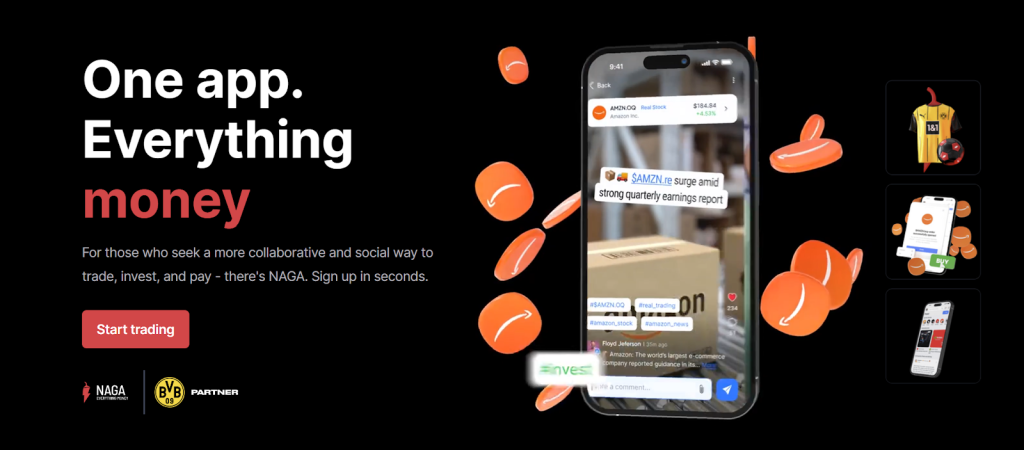
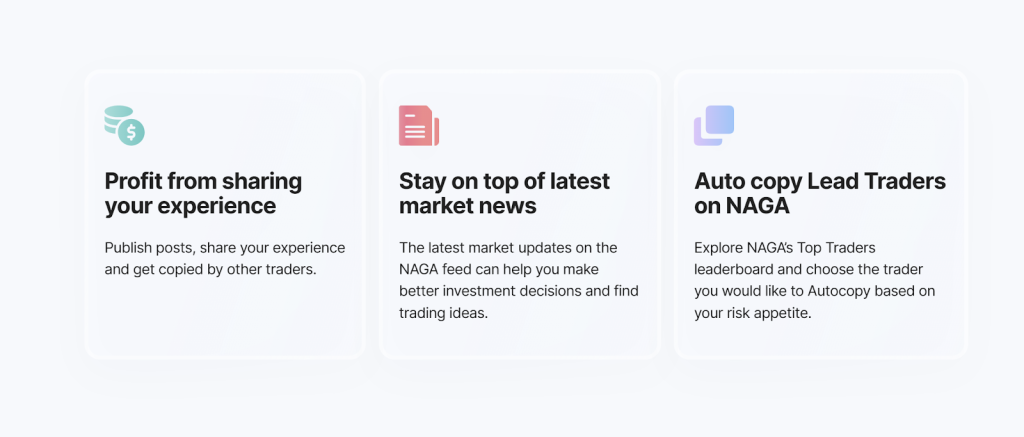
NAGA states that users can access stocks, CFDs on forex, indices, commodities, ETFs, bonds, and crypto through the platform, which gives it broad market coverage on paper. The broker positions itself around community interaction, copying lead traders, sharing market views, and following activity through a feed.
That social angle is either a plus or just extra clutter depending on the user. On the one hand, it makes the platform feel current and easier to navigate for people who dislike old-school broker dashboards. On the other, traders who prefer a more traditional setup may find the feed-driven style distracting over time. This is one of the more important things to mention in a balanced NAGA review, because it shapes the user experience more than a simple feature checklist would suggest.
Security, payments, and support
On the operational side, NAGA’s web app page says the platform supports multiple deposit and withdrawal methods, while the contact page lists customer support availability from Monday to Friday, 07:30 am to 02:00 am EEST, including live chat and contact options. The company also identifies operating entities and licensing information on its pages, which gives users something concrete to verify.
That said, support quality is never judged by opening hours alone. External feedback helps a bit here. On Trustpilot, NAGA has a 4.1 rating from over 4,000 reviews, pointing to generally positive but mixed feedback. The NAGA review on Review Charts and user feedback on Trustpilot can add useful third-party context alongside the official site.
Final thoughts
If I had to sum up this NAGA review plainly, I’d say NAGA looks strongest when viewed as a modern, social trading ecosystem rather than a bare-bones broker. The product range is broad, the platform design is polished, and the web-mobile continuity seems well thought out. The main downside is that the interface and social layer may feel a little too full for users who prefer simplicity.
CFDs are complex instruments and come with a high risk of losing money rapidly due to leverage. 67.24 % of retail investor accounts lose money when trading CFDs with this provider. You should consider whether you understand how CFDs work and whether you can afford to take the high risk of losing your money.